A list of my publications are provided here. Google scholar link is provided here. I will keep updating the list over time. These are only the articles that have been published in journals or conferences. Un-published works are listed under Projects.
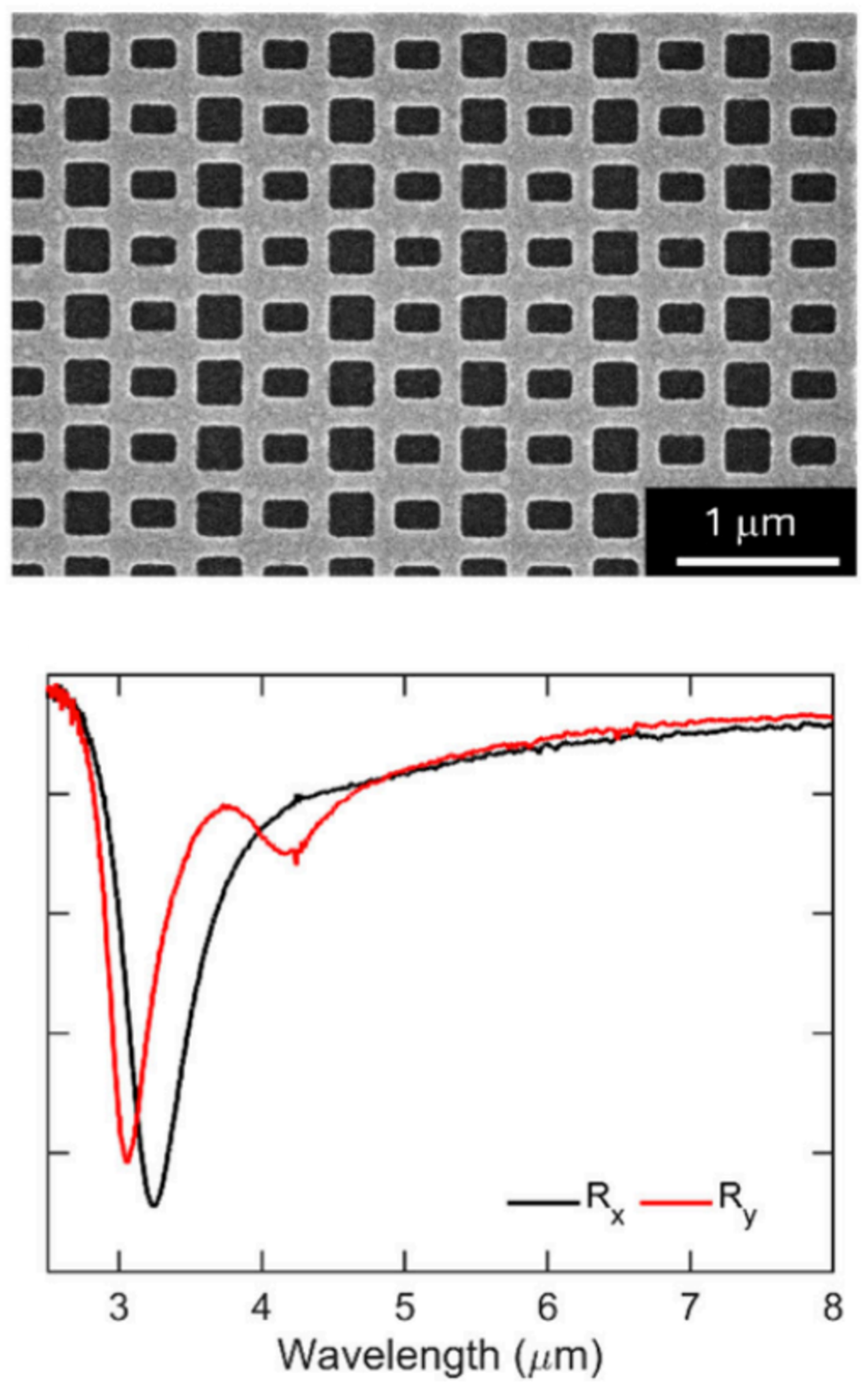
The ability to engineer multiresonant
absorption response in the
midwave infrared provides spectral information critical for detection
and sensing. We design and fabricate thin metal absorbers with a polarization-dependent,
multiresonant, and spectral response. Our approach exploits the coexistence
of a conventional Fabry-Peròt (FP) resonance and a geometry-enabled
resonance arising from symmetry breaking within a single, dilute-metal
structure. The resulting anisotropic geometry produces a polarization-dependent
response with a single resonance for x-polarized
light and dual resonances for the orthogonal polarization. The resonances
correspond to two fundamentally distinct physical mechanisms (i.e.,
cavity- and symmetry-driven); we experimentally verify our findings
and achieve dual-resonant thin metal structures. These findings are
promising for independently tailoring spectral position and line width
within a single compact structure.
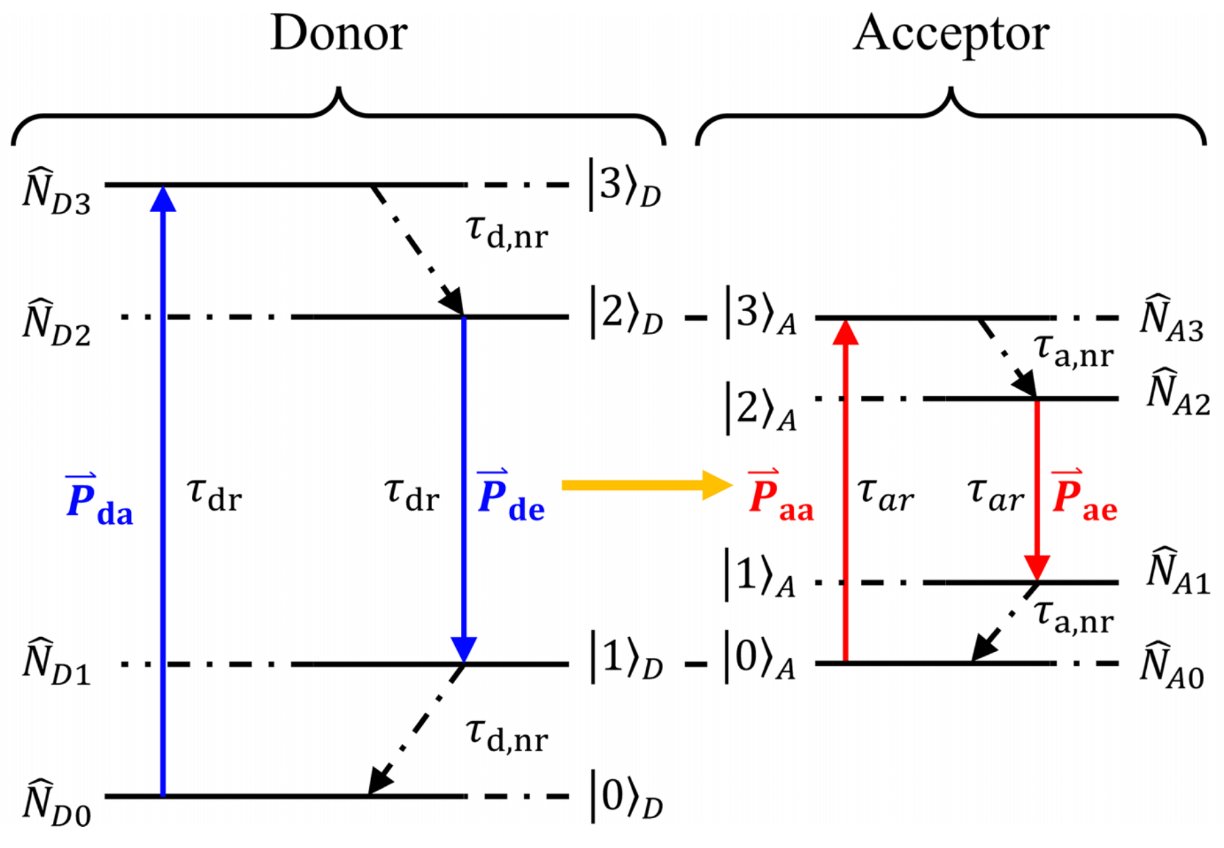
Nanoscale lasers that generate short pulses at high repetition rates have exciting applications in various fields. However, creating short pulses as well as broad frequency combs in nanoscale lasers is complex and remains a relatively unexplored area. Research has focused on materials with two or more types of resonantly coupled dyes for applications in energy harvesting, biocentered uses, and expanding the tuning range of lasers. We propose that a gain medium composed of two types of coupled dye molecules can produce the saturable gain and absorption necessary for short-pulse generation. We present a mathematical model for this proposed two-dye gain material and integrate it with a finite-difference time-domain method. This developed model is used to assess the effectiveness of the two-dye material for pulse shortening in miniature lasers and to explore the role of a simple one-dimensional photonic cavity in pulsed laser operation. Additionally, we investigate various possible modes of laser operation by varying key design parameters of the dye molecules and the cavity. The findings indicate that the proposed laser can emit a train of short pulses and frequency combs with appropriate tuning of both the laser medium and the cavity. When the parameters of the material and cavity are optimally adjusted, the two-dye gain-medium-based laser is capable of emitting subpicosecond pulses at repetition rates in the hundreds of gigahertz.
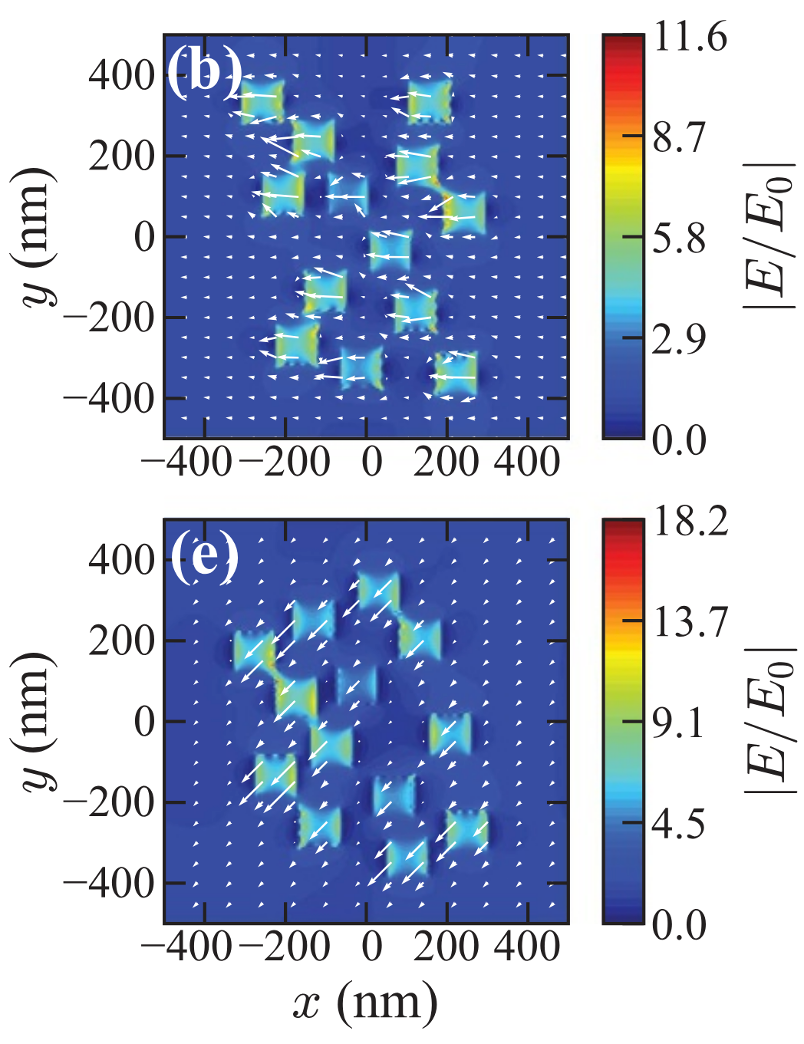
Extraordinary optical transmission (EOT) through metal nanohole arrays (NHAs) and Tamm plasmon (TP) states have been investigated in plasmonic devices since 1998 and 2007, respectively. Since their introduction, various potential applications for structures that support these phenomena have been reported, including plasmonic absorbers, lasing cavities, and narrowband filters. The performance of EOT- and TP-based devices is significantly influenced by the sizes and patterns of the holes in the NHA. While the effects of hole size and shape on EOT have been extensively studied, similar research on TP structures involving metal NHAs is still lacking. Particularly, the impact of gradually introducing randomness into the metal NHA on TP modes has yet to be explored. In this work, we modify the hole sizes and arrangements of the metal NHA and examine the effects on EOT and Tamm resonances. We investigate three scenarios: the bare metal NHA, a passive Tamm resonant cavity, and a TP laser. We observe that multiple Tamm resonances appear as the periodicity of the holes increases. However, these resonances vanish when the hole arrangement shifts from a regular array to a pseudo-periodic random array, which is defined as a collection of holes placed randomly within a periodically repeating square unit cell. These multiple resonances can be attributed to the folding of dispersion lines in a periodically patterned TP cavity. The dispersion characteristics of the NHA array-based structures are calculated and analyzed to understand better the multiple resonances in the transmission and lasing emission patterns.
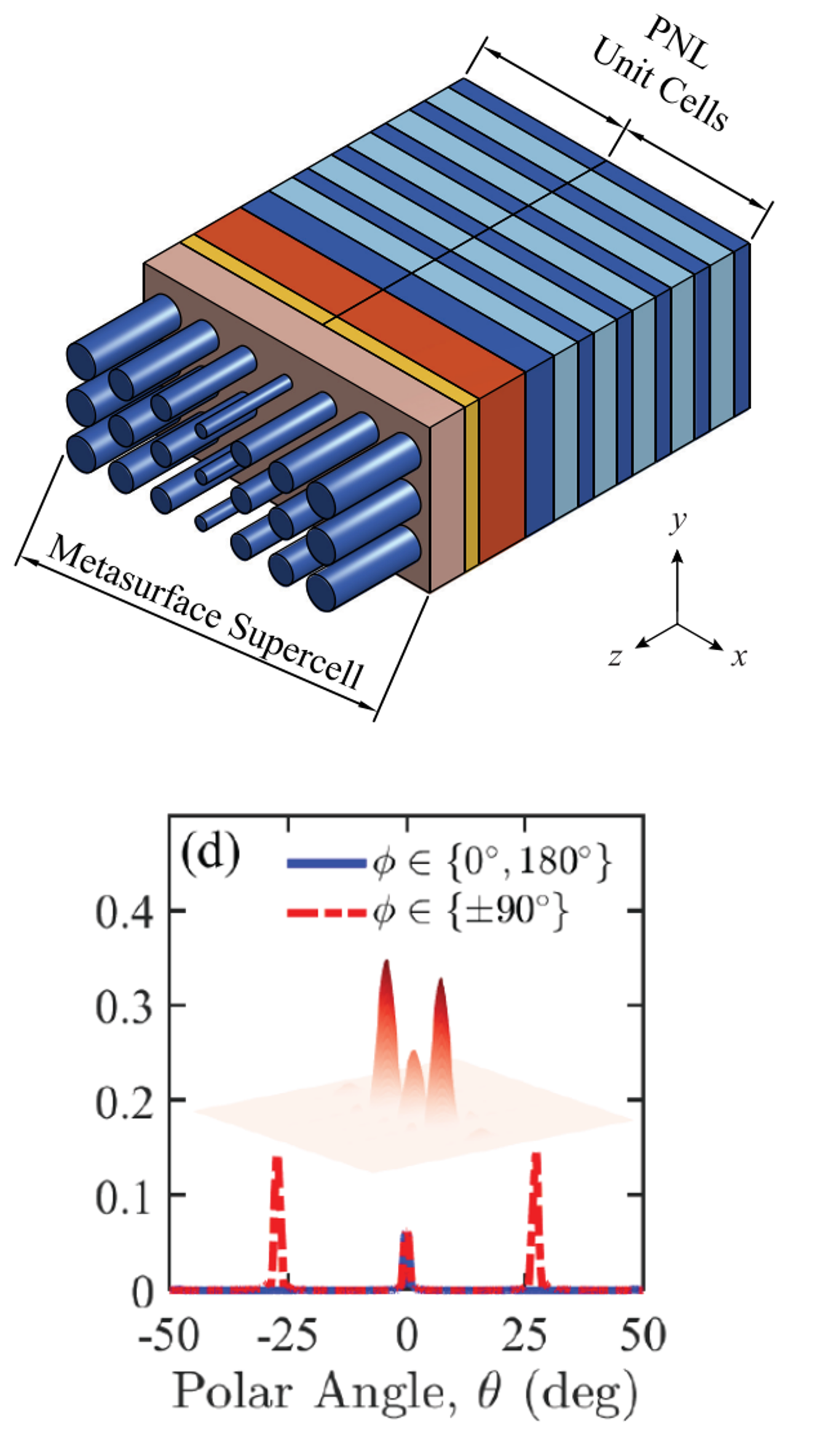
Due to its improved localization and confinement of light in single or multiple wavelength modes, nanolasers based on plasmonic crystals have grown in popularity in recent years. However, the lasing modes are not spatially separated, making applying different modes to different applications difficult. This work demonstrates an effective technique for spatially separating the two modes of a merged lattice metal nanohole array-based dual-mode plasmonic laser. A flat dielectric metasurface-based beam-splitter that exploits phase gradient profiles on the interfaces has been added to the laser to separate the modes into distinct spatial beams. The proposed structure successfully separates two modes by ∼23°, and the separation can be raised to ∼63° by tuning structural parameters such as the radius of the nanocylinders and the number of supercell rows. In addition, multiple beams can be generated, allowing for manual beam steering. This approach has a high emission output with a narrow linewidth, clarity, and a substantial degree of future tunability potential. The proposed integrated structure will provide a novel means of device miniaturization and may also serve advanced optical applications such as optical communication, quantum optics, interferometry, spectroscopy, and light detection and ranging (LiDAR).
Miniature lasers emitting dual-wavelength modes have diverse applications alongside the more explored single-mode counterparts. However, having dual-wavelength modes originating from a plasmonic-photonic hybrid laser is still a relatively new area for research. Compared to the amount of literature devoted to the physics of such hybrid cavities, only a few have analyzed their role in lasing applications. Notably, the role of hybrid cavities in dual-wavelength lasing is still unexplored. In this work, the properties of one-dimensional distributed Bragg reflectors and thin metal nanohole arrays come together to create a hybrid dual-mode plasmonic laser. The similar energy distribution characteristics of photonic and plasmonic lasers make hybrid structures a viable choice for efficient dual-mode lasing. In this work, the lasing cavity simultaneously excites photonic and Tamm plasmonic modes to generate dual-mode lasing. Consequently, the proposed laser shows high emission output with narrow linewidth and a clear and tunable mode separation.
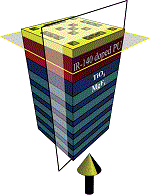
Plasmonic lasers offer great potential for cutting-edge, disruptive applications. However, they suffer from a high loss in metals, lack of spatial coherence in the near field, and divergent far-field emission. The challenges are even more significant for a plasmonic laser emitting more than one wavelength mode. The design complexity required for creating multiple modes often limits avenues for minimizing losses and converging far-field emission patterns. This work exploits plasmonic resonances at the junction of a merged lattice metal nanohole array (NHA) and a one-dimensional photonic crystal to achieve dual-mode lasing. The merged lattice NHA is designed by concentrically combining two simple NHAs with different periodicities to create pseudo randomness, leading to enhanced localization and confinement of light in multiple wavelength modes. The proposed structure notably produces intense dual-mode lasing at an ultra-low threshold compared to recent state-of-the-art plasmonic laser demonstrations. The wavelengths of the lasing modes and the separation between them can be tuned over a broad range by changing the structural parameters. The proposed laser also creates a highly directional far-field pattern with a divergence angle of only <0.35°.
 Physical Review A, Jul 2025
 New Journal of Physics, Jan 2025
 Optics Express, May 2024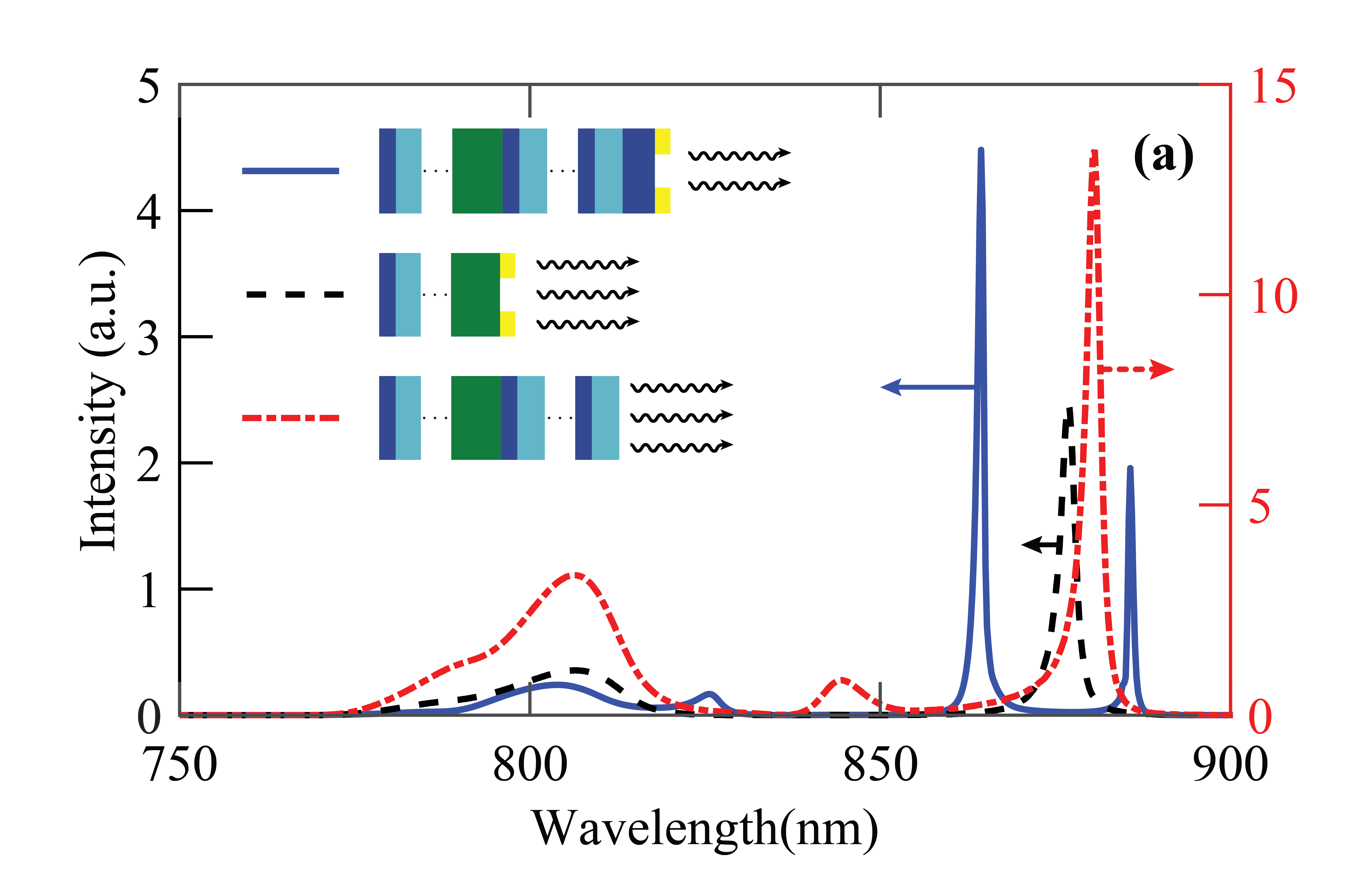
 Nanoscale Adv., Jul 2022